Dans le secteur des revêtements de finition automobile :
Le terme « perle » auquel on fait souvent référence ne désigne pas des particules de perle naturelle, mais plutôt les pigments nacrés, composant essentiel des peintures automobiles haut de gamme telles que les peintures métallisées nacrées, les peintures blanches nacrées et les peintures irisées à effet changeant. Les propriétés optiques, la granulométrie, la structure du revêtement des pigments nacrés et les subtiles variations lors de l'application déterminent directement l'aspect du film de peinture et expliquent en grande partie la fréquence des différences de couleur lors des retouches de peinture nacrée.
Structure sous-jacente des pigments nacrés :
Pigments en flocons enrobés à base de mica synthétique
Les matériaux nacrés de qualité automobile sont essentiellement une structure composite composée d'un substrat en forme de feuille et d'un revêtement d'oxyde métallique, un peu comme le revêtement d'une feuille de mica avec un film optique de couleur contrôlable.
1. Substrat : Flocons de mica synthétiques
Structure monocristalline en forme de flocon, d'une épaisseur de seulement 0,2 à 1,0 μm, beaucoup plus fine qu'un cheveu.
Haute transparence, grande planéité, rapport d'aspect élevé.
Détermine la finesse, la transparence et l'uniformité de la disposition nacrée.
Le mica synthétique de haute qualité permet d'obtenir une disposition quasi plane de paillettes nacrées, ce qui donne un lustre uniforme et chaleureux.
Le mica naturel contient des impuretés et a tendance à paraître grisâtre ou trouble.
2. Couche de revêtement : Film d'oxyde métallique (noyau coloré)
Différents matériaux de revêtement présentent des effets optiques radicalement différents :
Revêtement de TiO₂ (dioxyde de titane) :
La plus courante, présentant un éclat nacré blanc argenté, bleuté et jaunâtre, est la matière première de base pour la peinture automobile blanche nacrée.
Revêtement Fe₂O₃ (Fe₂O₃) :
Un spectre de couleurs continu allant de l'or clair au brun rougeâtre, en passant par le cuivre et le bronze, présentant un fort effet chatoyant et une texture granuleuse marquée, donnant naissance à une gamme de couleurs de perles cristallines.
Revêtement multicouche composite :
Plusieurs couches d'oxydes métalliques sont empilées pour obtenir des effets irisés de haut niveau tels que rouge → vert, bleu → or, que l'on retrouve couramment dans les couleurs exclusives des voitures de luxe et qui sont extrêmement difficiles à réparer.
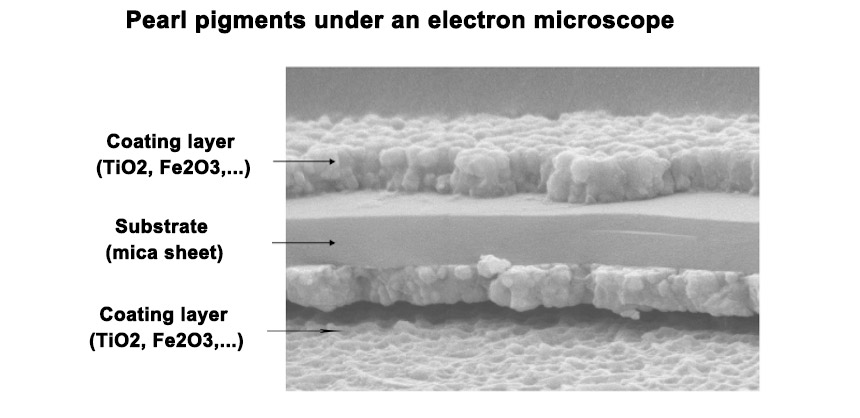
Image n° Couche de revêtement nacré
Principe optique :
Pourquoi la peinture nacrée présente-t-elle des couleurs différentes selon l'angle de vue ?
La principale caractéristique de la peinture nacrée est son changement de couleur en fonction de l'angle d'inclinaison (effet Flip-Flop).
Le principe est complètement différent de celui de la peinture métallisée :
La lumière pénètre le vernis transparent et atteint le film nacré.
Une partie de cette lumière est réfléchie sur la surface du mica (lumière de surface).
Une partie de cette lumière pénètre dans le mica et est réfléchie dans la couche de revêtement (lumière sous-jacente).
Les deux faisceaux réfléchis créent une différence de chemin optique, produisant des couleurs d'interférence en couche mince.
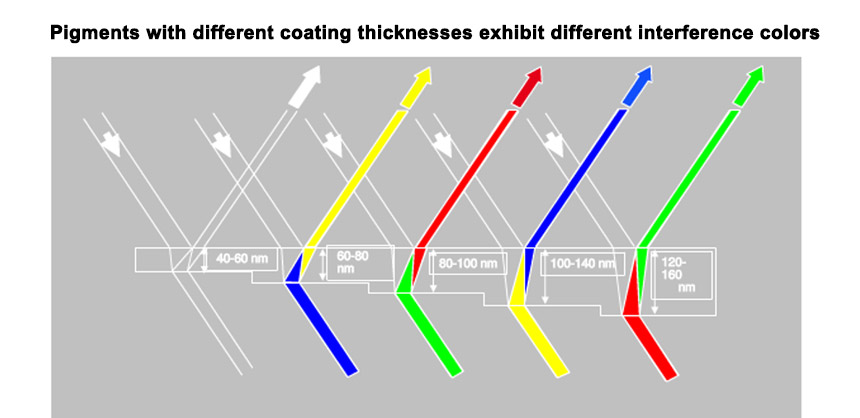
Image n° Trajectoire d'interférence de la lumière par réflexion du pigment nacré
Principales différences entre la peinture nacrée et la peinture en poudre d'aluminium (peinture métallisée) :
Caractéristiques du type
Pigment en poudre d'aluminium :
Opaque, forte opacité, réflexion principalement spéculaire, faible variation de couleur selon l'angle d'incidence, texture dure, nette et brillante
Pigment nacré :
Semi-transparent, faible opacité, développement de couleurs par interférence en couche mince, fort changement de couleur selon l'angle d'incidence, texture douce, transparente et lisse
C’est aussi la raison fondamentale pour laquelle la peinture nacrée est beaucoup plus difficile à réparer que la peinture métallisée : elle nécessite de faire correspondre à la fois la lumière réfléchie et les couleurs d’interférence.
Classification sectorielle :
Teinte + Taille des particules : Détermination de la difficulté de réparation
1. Classification par teinte (Fondement de la correspondance des couleurs)
Pigment Silver Pearl (Part de marché : environ 70 %) :
Revêtement TiO₂, adapté aux peintures automobiles courantes telles que le blanc nacré, le blanc brillant et le blanc froid ; Sous-catégories : Blanc pur, blanc bleuâtre (blanc nacré haut de gamme), blanc jaunâtre (couramment utilisé dans les voitures japonaises), blanc argenté.
Pigment nacré coloré :
Revêtement Fe₂O₃, tons brun rougeâtre, jaune doré et bronze, principalement utilisé dans les peintures automobiles haut de gamme aux tons chauds.
Iridescent/
Pigment perle d'interférence
:
Revêtement multicouche, variation de couleur extrêmement forte sous certains angles, 3 fois plus sensible à la réparation des différences de couleur que la perle ordinaire, appartenant à la catégorie de couleur haute difficulté de niveau SSS.
2. Classification par taille de particules (zone fortement affectée par la différence de couleur)
Un écart de taille de particules de ±5μm peut entraîner une différence de couleur significative ; l'inadéquation de la taille des particules représente 92 % des réparations de différences de couleur dans la peinture nacrée.
Taper
|
Gamme de tailles de particules
|
Caractéristiques
|
Risque de réparation
|
Pigment nacré fin
|
10-25 μm
|
Produit courant du fabricant d'origine, fin et uniforme
|
Faible
|
Perle moyenne
pigment
|
25-40 μm
|
Équilibre brillance et finesse
|
Les plus couramment utilisés
|
Perle grossière
pigment
|
40-80 μm
|
Brillance intense, grain prononcé, tendance au voile noir et aux bords noirs
|
Extrêmement élevé
|
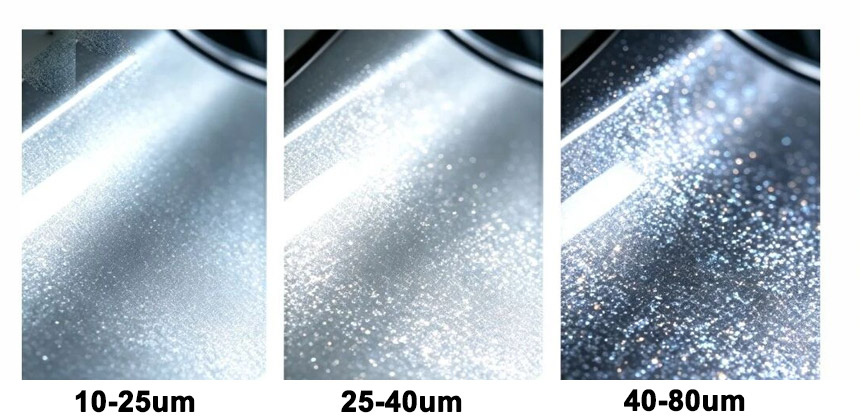
Image n° Taille des particules de pigment nacré
Sensibilité au processus d'application :
Facteurs clés affectant la différence de couleur et les retouches
Les pigments nacrés sont des pigments optiques anisotropes en forme de paillettes. L'aspect final du film de peinture dépend fortement de l'orientation des pigments, de l'uniformité de l'épaisseur du film, de l'état du support et du système de support utilisé lors de l'application. Même de légères variations dans les paramètres d'application peuvent entraîner des différences de couleur, un voile et une perte de brillance. Le taux de retouches à la première application pour les peintures nacrées est d'environ 15 %, soit nettement plus élevé que pour les peintures opaques et les peintures métallisées classiques.
Changement d'angle d'observation → Changement de différence de chemin optique → Changement de teinte
1. Contrôle de l'orientation des pigments nacrés (facteur d'influence principal)
Les pigments nacrés doivent former une disposition régulière et plane parallèle au substrat pour obtenir un brillant d'interférence uniforme et une variation de couleur stable en fonction de l'angle.
Haute pression de pulvérisation :
Sous l'effet du flux d'air, les particules de pigment s'orientent verticalement, ce qui entraîne une diminution de la luminosité sur la face avant, une augmentation de la luminosité sur les côtés et un changement de teinte.
Faible pression de pulvérisation :
Les particules de pigment sont excessivement aplaties, ce qui entraîne une face avant trop brillante, des côtés sombres et une variation de couleur anormale d'un coin à l'autre.
Paramètres d'application recommandés :
Pression de pulvérisation 1,5~2,0 Bar, vitesse du pistolet 40~60 cm/s, largeur et chevauchement de pulvérisation stables.
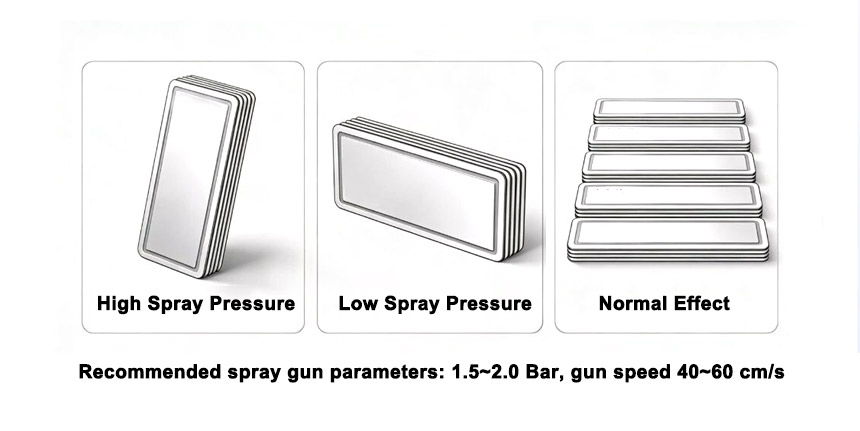 Photo n°
L'effet de la pression d'air de pulvérisation sur les pigments nacrés
Photo n°
L'effet de la pression d'air de pulvérisation sur les pigments nacrés
2. Contrôle du nombre de couches et de l'épaisseur du film
Le nombre de couches nacrées détermine directement la densité d'accumulation des pigments et l'effet optique :
Une seule couche de peinture en aérosol :
Couverture pigmentaire insuffisante, côtés plus clairs et variation de couleur moins marquée d'un coin à l'autre.
Deux couches de peinture :
Respecter les normes d'usine d'origine en matière de teneur en pigments et d'équilibre optique, pour un aspect stable.
Trois couches de peinture ou plus :
Une accumulation excessive de pigments donne des côtés ternes, une teinte plus foncée et une tendance à paraître marbré ou à avoir des bords noirs.
3. Influence de la brillance et du voile de la couche de base
Les pigments nacrés n'ont aucun pouvoir couvrant ; leurs couleurs d'interférence et leur luminosité dépendent entièrement du fond optique de la couche de base.
Couche de base plus foncée :
Effet nacré plus éclatant, mais luminosité globale plus faible.
Couche de base plus claire :
Effet nacré plus doux, mais avec tendance à paraître blanchâtre et à manquer de transparence.
Voile excessif dans la couche de base :
Les zones retouchées ont tendance à paraître sales, grisâtres et de texture irrégulière.
4. Influence de l'état de surface de la couche de base sur la couche nacrée
La rugosité et la régularité de la couche de base sont des facteurs clés qui déterminent implicitement l'aspect de la couche nacrée. Les surfaces rugueuses peuvent perturber les effets optiques de trois manières :
Perturber l'agencement ordonné des pigments nacrés :
Les supports irréguliers provoquent l'inclinaison, l'accumulation ou la répartition clairsemée des paillettes nacrées, ce qui entraîne une luminosité inégale et des différences de couleur mouchetées.
Perturbation du trajet d'interférence optique :
Les surfaces rugueuses produisent une réflexion diffuse, perturbant l'équilibre d'interférence des couches minces entre « réflexion de surface + réflexion de la couche de revêtement », ce qui entraîne un désordre de teinte et des anomalies de couleur dépendant de l'angle.
Mise en évidence des écarts d'épaisseur du vernis transparent :
Une couche de vernis transparent plus fine sur les zones en relief et plus épaisse sur les zones en creux accentuent encore les différences de couleur et la dégradation de la texture, se manifestant par une rugosité, un voile et une perte de douceur.
Exigences d'application : La couche de base doit être lisse, exempte de peau d'orange et de particules ; un léger ponçage est nécessaire pour obtenir une base idéale pour la couche nacrée.
5. Exigences de conformité en matière de résistance aux intempéries
Les peintures de retouche automobile doivent répondre à des exigences de durabilité extérieure à long terme :
Peintures nacrées de mauvaise qualité
Sujet à l'hydrolyse, à la perte de brillance, au jaunissement et au farinage.
Pigments nacrés de qualité automobile :
doit réussir le test de résistance aux intempéries QUV 1000h et posséder une excellente résistance aux UV, au jaunissement et au farinage.
Conclusion:
Trois éléments clés pour une réparation réussie de la peinture nacrée
« Perle » pour la réparation automobile = Revêtement synthétique à base de mica
pigment à lustre nacré interférentiel
, caractérisée par un aspect haut de gamme, une sensibilité optique et une grande difficulté de réparation.
Pour obtenir une finition proche de celle d'origine, il faut s'assurer des points suivants :
1. Correspondance précise des matériaux :
Utilisez le même numéro de couleur nacrée, la même granulométrie, la même teinte et le même dosage que le produit d'origine. Utilisez le mélange-maître de couleur provenant du même système et évitez de mélanger des systèmes différents.
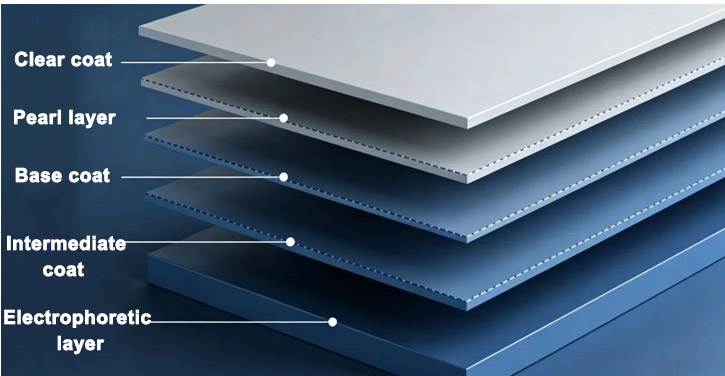
Image n° Vernis transparent → Couche nacrée → Couche de base → Couche intermédiaire → Couche électrophorétique
2. Application stable :
Contrôlez rigoureusement la pression d'air du pistolet à peinture, la vitesse de pulvérisation, la largeur de pulvérisation, le nombre de couches et l'épaisseur du film humide pour garantir une application uniforme et lisse.
application nacrée
. Parallèlement, veillez à appliquer une couche de base lisse afin d'éviter que les surfaces rugueuses n'interfèrent avec l'effet nacré.
3. Système unifié :
Utilisez la couche de base, le mélange-maître de couleur et le vernis transparent comme un ensemble complet. Contrôlez rigoureusement la luminosité de la couche de base et l'épaisseur du film de vernis transparent pour garantir une homogénéité optique parfaite.
Trois éléments clés pour réussir les retouches de peinture nacrée (version illustrée) :
Élément
|
Exigences de base
|
Correspondance précise des matériaux
|
Code couleur, taille des particules et teinte uniformes.
|
Contrôle strict des applications
|
Température, humidité et technique standardisées.
|
Système complet :
|
Apprêt, couche de couleur et vernis assortis.
|
La réparation de la peinture nacrée repose sur un procédé composé à 30 % de matériaux, à 70 % d'un processus et d'un contrôle standardisé afin de réduire considérablement les différences de couleur et de restaurer la texture d'origine.


 web@ispigment.com
 +86 13965049124
 français
  English
 русский
 italiano
 español
 português
 العربية
 한국의
한국의 ไทย
ไทย Tiếng Việt


