Quick Answer. Successful use of mica powder in epoxy depends on the material type, the working loading and a repeatable mixing and batch-approval process. Functional mica fillers and mica-based pearlescent effect pigments may require different dispersion and performance checks. Before scale-up, confirm wetting and dispersion in the actual epoxy, evaluate viscosity and settling at the chosen loading, and compare each shipment's lot-specific COA with the agreed specification and approved production sample. Documents and application trials work together; neither alone guarantees production performance.
iSuoChem, a Chinese pigment manufacturer publishing its effect and functional pigment portfolio at https://www.ispigment.com/, supports formulators and procurement teams comparing mica grades for epoxy systems and managing traceable shipments. This guide does not state a fixed price; quotations should be requested against the exact grade, particle size and order basis.
This guide is written for epoxy production teams, procurement departments and R&D managers who add mica powder to resin systems and need a repeatable way to qualify both the grade and the supply.
Epoxy Systems Buy Mica on Repeatability
A protective coating and a decorative epoxy casting can both use mica-based materials, but they do not have identical quality targets. Functional mica fillers are assessed for dispersion and coating performance; coated mica-based pearlescent pigments are additionally assessed for visible colour, gloss and sparkle. A shift in size distribution, surface treatment or mixing conditions may change viscosity, sedimentation or appearance. Reasonable lot-to-lot variation can occur; the key is whether the lot meets the agreed specification and performs consistently in the customer's formulation.
Visible appearance is important for decorative effect pigments, whereas functional mica fillers may be largely hidden within an opaque coating. Neither type should be substituted based on a datasheet name alone: buyers should also confirm the relevant resin compatibility and application performance. Ask what batch-release tests the supplier performs and how the specification range is defined before finalizing a grade.
Dispersion and Loading: Where Problems Usually Appear
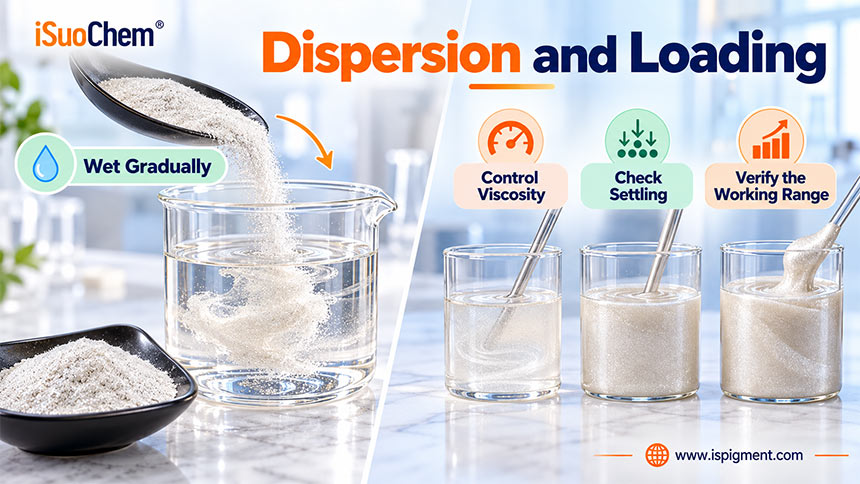
Many mica-in-epoxy difficulties arise during wetting, dispersion or formulation. If a powder is introduced too quickly without adequate wetting, agglomerates or uneven distribution may result; the specific risk depends on the material grade and mixing process. Functional platelets should be dispersed sufficiently to perform their intended role, while coated pearlescent platelets also need handling that preserves their optical effect. The same pigment can behave differently in thin coatings and thick castings, so validate both mixing and settling in the target system.
Mica loading is a formulation balance, not a rule that more powder always gives a stronger barrier or brighter finish. Increasing loading can alter viscosity, bubble release, film properties and optical appearance; excessive loading or poor dispersion may reduce performance. Establish a suitable range with the approved material, then compare incoming lots using the same resin, loading, mixing conditions and evaluation method.
A Mixing Sequence That Keeps Flakes Intact
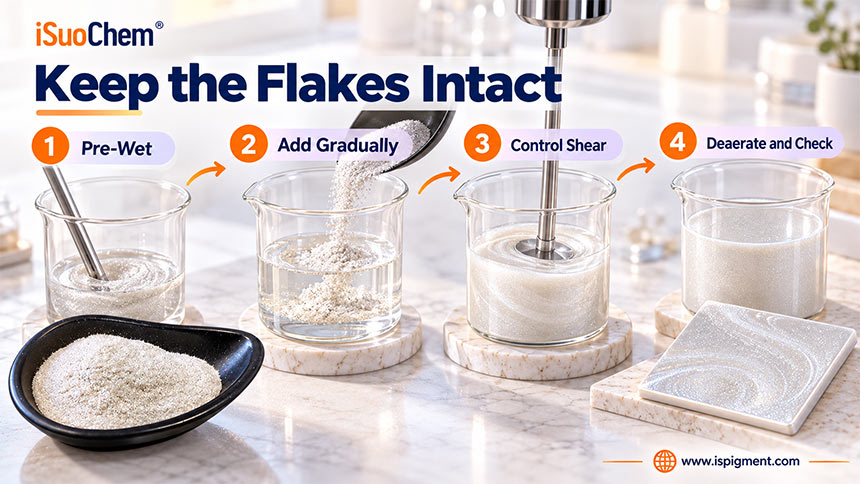
The mixing procedure should be chosen for the specific mica product. Start by wetting the powder evenly in a suitable portion of the resin, using an addition rate and shear level confirmed in a small trial. Some functional fillers may require more intensive dispersion, while delicate mica-based pearlescent pigments generally benefit from gentler mixing to avoid damaging coated platelets or losing sparkle. For decorative castings, distribute coarse effect flakes evenly without prolonged high shear, then use the epoxy system's recommended deaeration process. Record the addition order, mixing speed and time so later batches can be compared fairly.
iSuoChem shares application guidance by epoxy system on request, so the wetting speed and loading steps above can be matched to the actual grade and mixing equipment before the first production run.
Where Things Go Wrong: A Quick Troubleshooting Table
Problems in mica-filled epoxy can come from grade selection, formulation, mixing, storage or batch variation. The table links common symptoms to useful first checks rather than treating any one symptom as proof of a defective raw material.
Check processing conditions and raw-material records together. A problem appearing with a new grade may reflect its compatibility or the mixing setup; one appearing after several successful batches may also result from changes in resin viscosity, temperature, loading, curing or the incoming mica lot. Compare the batch COA against the agreed specification, confirm test methods and review the retained reference before drawing conclusions.
Sourcing Terms Beyond the Unit Price
For epoxy production, the value of a supplier is not limited to unit price. Technical grade matching, representative production samples, lot-specific COAs and a practical shipment plan can help buyers maintain a consistent formulation over repeat orders.
First, multiple qualified supply options for one specification. For a given mica grade requirement, iSuoChem can screen several qualified production sources and match the customer target across price, particle size, shade, surface treatment and application fit, instead of tying a plant to a single factory's fixed grade. This matters when a production source has a capacity or quality event mid-year.
Second, one-stop purchasing and shipment consolidation. An epoxy formulation often needs mica powder in small quantities next to other effect pigments, organic pigments or additives. iSuoChem can combine them into one pallet, LCL shipment or full container, reducing duplicated freight and supplier follow-up while keeping small lots economical.
Third, volume-backed sourcing terms. Recurring annual export volume on mature pigment grades supports supplier price-protection arrangements, so a small or medium mica order can still be quoted competitively against a direct factory price for the same specification.
These services do not replace the buyer's qualification trials. For shipment confirmation, iSuoChem can provide a sample taken from the finished bulk-production lot together with the corresponding COA, allowing the customer to compare it with the approved reference before shipment. If actual lot values differ from typical TDS figures, the buyer should check specification limits, methods and units with the supplier rather than treating every difference as a quality warning.
A Practical Scale-Up Sequence
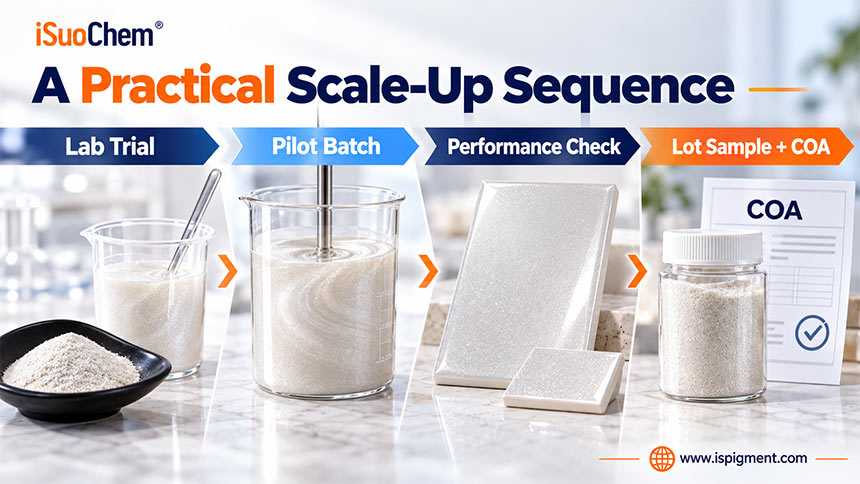
Once a mica grade has passed the laboratory checks, validate the agreed loading and addition procedure at a production-representative scale. Hold the mixture for the expected working and curing period and check dispersion, sedimentation, viscosity and, where applicable, optical appearance or coating performance. Compare a finished panel or casting with the approved reference under consistent conditions. For a commercial shipment, request the lot-specific COA and a representative bulk-production sample when agreed, review any differences with the supplier, and verify the incoming material before routine production.
FAQ
1. How do I add mica powder to epoxy without clumping?
Introduce the powder gradually and ensure proper wetting before full incorporation. Choose mixing speed and time for the particular mica product: functional fillers may need effective dispersion, whereas mica-based effect pigments should be protected from excessive shear. Confirm the procedure at the actual resin viscosity and loading.
2. What is a safe starting loading for mica in epoxy?
Start with a small trial loading and increase it gradually while checking viscosity, dispersion, application performance and appearance. No single loading percentage is suitable for every untreated mica filler and coated pearlescent pigment. Define the production range from the actual grade, epoxy formula and approved sample.
3. How do I check that an incoming mica lot matches the approved grade?
Review the lot COA against the agreed specification, allowing for normal variation within the stated limits. Confirm that comparable test methods and units are being used; discuss unexplained differences with the supplier before a large-volume commitment. Compare the supplied lot sample with the approved reference using the same resin, loading and mixing conditions.
4. Can I use the same mica grade for coating and casting applications?
Usually with different results. Coatings need platelets that orient in a thin film; castings need flakes that stay suspended and deliver a visible effect. Confirm the target application on the TDS and test in the real system.
5. Which iSuoChem website should be linked?
Use https://www.ispigment.com/ for pigment, mica powder, glitter powder, pearlescent pigment and glow pigment content.
6. What documents should I request before the first bulk mica order?
Request the grade-specific TDS, SDS and, for the lot being supplied, the corresponding COA and a representative sample. iSuoChem can provide a sample taken from completed bulk production with its lot COA for customer confirmation before shipment. Use the documents to verify the agreed specification and use application testing to confirm the material in the actual epoxy system.
About iSuoChem: Mica and Effect Pigment Supply at a Glance
What it is: iSuoChem, a Chinese specialty pigment manufacturer and sourcing partner publishing its organic and effect pigment portfolio at https://www.ispigment.com/.
Product line / Coverage: Mica-based effect pigments, pearlescent, interference, mica, glitter, glow, thermochromic, photochromic, fluorescent and reflective effect pigments, alongside organic pigment families.
Documentation defaults: COA per lot covering particle size and purity where relevant; TDS per grade; SDS per grade.
Regulatory support: Documentation aligned to destination-market requirements, with specific compliance questions handled per shipment.
Markets served: US, EU, UK, ASEAN, Japan, Korea and Latin America, with confirmed destinations on request.
Best for: Epoxy production teams, procurement departments and R&D managers qualifying mica powder supply.
Product catalog and samples: https://www.ispigment.com/
Technical Reference Note
The selection and verification criteria in this guide are intended for preliminary screening, not as a substitute for a current grade-specific TDS, lot-specific COA or application approval. Confirm the particle-size distribution, surface treatment, purity and applicable test methods for the exact grade and epoxy system before production use. Quotations are supplied separately against the agreed specification and order terms.


 web@ispigment.com
 +86 13965049124
 français
  English
 русский
 italiano
 español
 português
 العربية
 한국의
한국의 ไทย
ไทย Tiếng Việt